 By
By What Is HexClad?
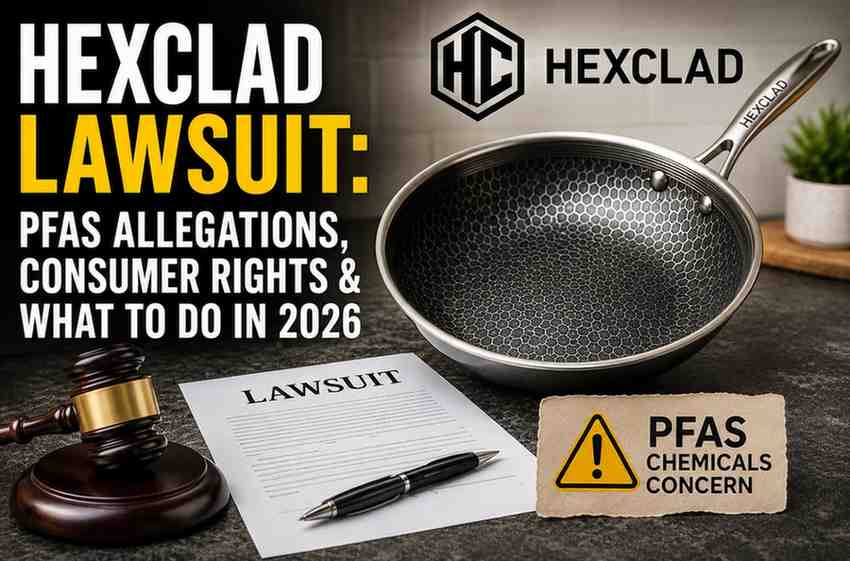
HexClad is a premium cookware brand headquartered in Los Angeles, California. The company is best known for its signature hybrid hexagonal pattern on pots and pans, which it claims combines the best of stainless steel with nonstick performance. HexClad products are celebrity-endorsed, most notably by chef Gordon Ramsay, and are sold at a significantly higher price point than typical nonstick cookware, with individual pans often retailing between $100 and $200.
The brand markets its cookware with language emphasizing safety, quality, and innovation. Phrases like “PFOA-free,” “safe for family use,” and “healthy cooking” appear throughout its website and advertising. It is exactly this marketing language that has drawn legal scrutiny and formed the basis of the HexClad lawsuit.
HexClad pans use a nonstick coating that, according to the company, is bonded into the metal surface using a laser etching process. The coating itself, however, has been alleged to contain PTFE — polytetrafluoroethylene, the same compound used in traditional Teflon and potentially other PFAS-related compounds, which contradicts or qualifies the brand’s “safe” and “non-toxic” messaging.
HexClad was founded in 2016 and rose to prominence partly through its Gordon Ramsay partnership beginning in 2020. The brand has generated hundreds of millions in sales, positioning itself as a healthier, higher-performing alternative to standard nonstick cookware, a positioning now at the center of legal scrutiny.
What Are PFAS and Why Do They Matter?
PFAS—per- and polyfluoroalkyl substances—are a group of more than 12,000 synthetic chemicals that have been used in manufacturing since the 1940s. They are often called “forever chemicals” because they do not break down naturally in the environment or in the human body. PFAS are found in nonstick cookware, water-resistant clothing, food packaging, firefighting foam, and many other products.
The health concerns associated with PFAS exposure are significant and well-documented. The EPA and multiple federal agencies have linked PFAS exposure to increased risk of certain cancers, thyroid disease, immune system disruption, fertility problems, and developmental issues in children. In 2024, the EPA finalized the first-ever national drinking water standards specifically targeting PFAS chemicals.
In the context of the HexClad lawsuit, the concern is not just that PFAS may be present in the coating, but that consumers were allegedly not told this and, in fact, were led to believe the opposite through the brand’s safety-oriented marketing. PFOA, a specific PFAS compound, was phased out of cookware manufacturing in the US, but PTFE (which falls under the broader PFAS umbrella by some definitions) is still widely used, including allegedly in HexClad’s coating.
WHAT ARE “FOREVER CHEMICALS”?
PFAS are called “forever chemicals” because they accumulate in the body over time and in the environment indefinitely. There is no safe way to eliminate them once they enter your system. Long-term, low-level exposure, as might occur from cooking daily in PFAS-containing pans is an area of active scientific and regulatory concern.
📡 Resource Block 1: Understanding PFAS
- EPA PFAS Action Plan — Official Regulatory Guidance
- NIH National Institute of Environmental Health Sciences — PFAS Health
- Environmental Working Group (EWG) — PFAS in Consumer Products
- Consumer Reports — PFAS: What You Need to Know
Core Legal Allegations
The HexClad lawsuit is grounded in several specific legal theories that consumer protection attorneys have used successfully in similar cookware and personal care cases. Here is what plaintiffs are actually alleging:
1. False Advertising and Deceptive Marketing
HexClad’s marketing prominently features the term “PFOA-free” while also using broader language about safety and healthy cooking. Plaintiffs argue this creates a misleading impression that the cookware is entirely free of all PFAS when, in fact, it allegedly contains PTFE, a fluoropolymer that is technically part of the PFAS chemical family. The strategic use of “PFOA-free” without disclosing the presence of other PFAS compounds is the center of the false advertising claim.
2. Unjust Enrichment Through Premium Pricing
HexClad pans cost substantially more than conventional nonstick cookware. Consumers paid this premium specifically because of the brand’s safety positioning. If that positioning was misleading, then HexClad allegedly profited unfairly from health concerns that consumers had every right to factor into their purchase decisions. This is the basis of the unjust enrichment theory in the HexClad lawsuit.
3. Breach of Implied Warranty
When a product is marketed as safe for food preparation and free of harmful chemicals, the law implies a warranty that the product will meet that standard. If the nonstick coating releases PFAS compounds under normal cooking conditions, especially at high temperatures, then the product may fall short of its implied warranty, giving consumers grounds for a legal claim.
4. Violations of State Consumer Protection Statutes
States like California (under its Consumer Legal Remedies Act and UCL), New York, Texas, and Illinois all have consumer fraud statutes that allow buyers to pursue damages for deceptive marketing. The HexClad lawsuit is expected to invoke multiple state laws, which is typical for class actions involving consumer goods sold nationally.
LEGAL NOTE: PFOA-FREE ≠ PFAS-FREE
This distinction is critical to the lawsuit. PFOA (perfluorooctanoic acid) is one specific PFAS compound that was phased out of US manufacturing. A product labeled “PFOA-free” may still contain other PFAS substances, including PTFE. Critics argue brands use “PFOA-free” labeling precisely because it sounds comprehensive while technically being narrow.
Which Products Are Affected?
The HexClad lawsuit and related consumer complaints primarily concern HexClad’s core hybrid cookware line, including its frying pans, skillets, woks, and cookware sets. These products span a wide price range and have been sold widely through HexClad’s website, Costco, Amazon, and high-end kitchen retailers across the United States.
Product lines most frequently cited include HexClad hybrid frying pans in 8″, 10″, and 12″ sizes, HexClad woks, and bundled cookware sets, which are among the brand’s most popular offerings. Given the brand’s national distribution, the affected consumer pool is potentially very large, making this an ideal candidate for class action treatment.
Where Was HexClad Sold?
HexClad cookware has been sold at HexClad.com, Costco (in-store and online), Amazon, Williams Sonoma, and select Sur La Table locations. Your Amazon order history, Costco purchase records, or bank/credit card statements can serve as purchase documentation if you no longer have a receipt.
Who Qualifies to Join?
You may be eligible to participate in the HexClad lawsuit if you meet the following typical criteria. Final eligibility is determined by the court and the specific complaint terms, which can evolve as the case develops:
- You purchased HexClad cookware in the United States for personal or household use.
- Your purchase was made during the relevant class period (generally 2018 to present).
- You relied on HexClad’s safety or non-toxic marketing claims when making your purchase.
- You paid a price premium compared to equivalent non-PFAS-marketed cookware.
- You are a US resident aged 18 or older.
- You did not purchase the cookware for resale or commercial kitchen use.
If you experienced health symptoms you believe may be connected to prolonged use of HexClad cookware, you may also want to speak with a personal injury attorney about pursuing an individual claim in addition to or instead of joining the class action. Individual claims are appropriate when personal damages are significant and well-documented.
⚖️ Resource Block 2: Legal Options for Consumers
- ClassAction.org — Search Active Cookware & PFAS Lawsuits
- Top Class Actions — Open PFAS & Cookware Settlements
- National Consumer Law Center — Your Rights Under State Consumer Laws
- FTC Report Fraud — File a Consumer Product Complaint Online
Potential Compensation
The type and amount of compensation available in the HexClad lawsuit depend on how the case resolves through a negotiated settlement or a court judgment and how many consumers submit valid claims. Based on precedent from similar PFAS and cookware false advertising cases, consumers may be eligible for the following:
- Partial or full cash refunds on qualifying HexClad product purchases
- Product replacement or credit as an alternative form of relief
- Injunctive relief requiring HexClad to change its labeling and marketing claims
- Medical monitoring in cases involving documented health exposure concerns
- Attorney’s fees paid by the defendant, not out of consumer awards
In recent PFAS-related class action settlements involving consumer goods, including cases against DuPont, 3M, and various cookware brands, compensation for individual class members has ranged from $15 to several hundred dollars per person, depending on the scope of harm and the total settlement fund. High-value individual claims involving documented health effects can result in substantially larger recoveries outside the class structure.
What to Do Right Now
If you purchased HexClad cookware and are concerned about the issues raised in the HexClad lawsuit, take these steps immediately to preserve your options:
- Document Your Purchase
Locate receipts, Amazon or Costco order history, credit card statements, or any email confirmation showing you purchased HexClad cookware. Screenshot any HexClad marketing claims you saw before buying if you still have access to them.
- Keep the Cookware
Do not discard your HexClad pans. Physical product packaging, especially with label claims visible, may be relevant evidence. The pans themselves may be tested if the case proceeds.
- Search Active Case Databases
Visit ClassAction.org and TopClassActions.com and search “HexClad” to find open filings. Register your interest with the legal team to stay informed about case developments and claim deadlines.
- Consult a Consumer Protection Attorney
Most class action lawyers work on contingency, with zero upfront fees, paid only if you receive compensation. A free consultation costs you nothing and helps you understand your specific options.
- File a Complaint With the FTC
Submit a report at ReportFraud.ftc.gov. Consumer complaints are aggregated by federal regulators and help build the evidentiary record for enforcement actions and related lawsuits.
- See a Doctor If You Have Health Concerns
If you have experienced symptoms you suspect may be related to PFAS exposure through cooking, consult a physician. Document these visits; medical records are important evidence if you pursue an individual claim.
STATUTES OF LIMITATIONS DO NOT WAIT
Consumer fraud and product liability claims in most states expire within 2 to 6 years of the purchase or discovery of harm. If the deadline passes, you permanently lose the right to seek compensation. Contact an attorney as soon as possible to understand the deadline that applies in your state.
The Bigger Picture: PFAS Cookware Litigation
The HexClad lawsuit is part of a sweeping national trend of PFAS-related litigation that has targeted some of the largest companies in the world. In 2023, 3M agreed to pay up to $10.3 billion to settle PFAS contamination claims from US public water systems. DuPont and its spinoffs settled for over $1 billion. The legal pressure on PFAS manufacturers and users has never been greater.
In the cookware sector specifically, brands including Teflon/DuPont, Scanpan, and several Chinese manufacturers have faced consumer lawsuits over PFAS disclosure. What makes the HexClad case distinct is the premium price point and the explicit “safe” and “healthy” marketing language used by the brand, raising the stakes of the deception allegation considerably.
Regulators have also moved. The EPA’s 2024 drinking water PFAS standards signal that the government treats PFAS exposure as a serious public health issue — not a theoretical risk. Consumer advocates expect this regulatory momentum to translate into more aggressive enforcement and more successful class action outcomes in product-level PFAS cases.
🔬 Resource Block 3: PFAS Litigation & Regulatory Context
- EPA: 2024 PFAS National Drinking Water Standards — Official Rule
- FTC Truth in Advertising — What “Safe” and “Non-Toxic” Claims Must Prove
- US DOJ Consumer Protection Branch — Federal Enforcement
KEY TAKEAWAYS
- The HexClad lawsuit centers on allegations that the brand falsely marketed its hybrid cookware as safe and non-toxic while the nonstick coating allegedly contains PFAS compounds, including PTFE.
- The key legal distinction is that “PFOA-free” does not mean “PFAS-” and HexClad’s marketing allegedly blurred this important line for consumers.
- Core allegations include false advertising, unjust enrichment through premium pricing, breach of implied warranty, and violations of state consumer protection laws.
- US consumers who purchased HexClad cookware, particularly between 2018 and the present, may qualify to join the class action.
- Compensation could include cash refunds, product replacement, medical monitoring, and injunctive relief requiring marketing changes.
- Class action attorneys work on contingency. There is no upfront cost to consult with legal counsel or join a class.
- Statutes of limitations vary by state (typically 2–6 years); waiting too long permanently bars recovery.
- Even without a receipt, purchase proof from Amazon, Costco, or credit card records is usually sufficient.
- Filing a complaint with the FTC is free and contributes to federal enforcement momentum.
- The HexClad case fits within a major national wave of PFAS litigation, a trend backed by increasing EPA and DOJ regulatory action.
FREQUENTLY ASKED QUESTIONS
Does HexClad actually contain PFAS?
HexClad’s nonstick coating uses PTFE — polytetrafluoroethylene, which is classified as a fluoropolymer and falls within the broader PFAS chemical family by many definitions used by researchers and regulators. HexClad markets its products as “PFOA-free,” which is accurate for that specific compound, but does not necessarily mean the cookware is free of all PFAS substances. This distinction is the legal crux of the lawsuit.
Is it safe to keep using my HexClad pans while the lawsuit is pending?
This is a personal health decision best made with guidance from your doctor. Most PFAS health concerns from cookware are associated with long-term, sustained exposure, particularly when pans are overheated or the coating becomes scratched or degraded. If you have concerns, stop using the pans and store them for potential use as evidence. Do not discard them.
Does Gordon Ramsay’s endorsement of HexClad affect the lawsuit?
Celebrity endorsements do not create direct legal liability for the endorser in most consumer fraud cases. However, the prominent use of a celebrity chef’s endorsement may amplify the reach and impact of the allegedly misleading marketing, which could support the argument that consumers reasonably relied on those safety claims when making purchases. The legal claims run against HexClad the company, not Gordon Ramsay personally.
How is the HexClad lawsuit different from other PFAS cookware cases?
What distinguishes the HexClad case is the combination of a very high price point, aggressive “safe” and “healthy” marketing, and a high-profile celebrity endorsement. Most traditional nonstick cookware brands don’t lean as heavily on health-safety claims as part of their core identity. HexClad’s entire brand proposition is built on being a better, cleaner pan, which makes the PFAS allegation particularly damaging and legally significant.
What is the difference between opting in and opting out of a class action?
In most US class actions, you are automatically included as a class member if you meet the eligibility criteria. To receive compensation from a settlement, you must actively submit a claim. If you want to preserve the right to sue HexClad individually because you believe your personal damages are larger than what the class settlement offers, you must formally opt out before the court-set deadline. If you take no action, you receive nothing but also release your individual claims once the settlement is finalized.
Are there PFAS-free cookware alternatives I can use instead?
Yes. Cookware made from cast iron, carbon steel, stainless steel, or ceramic (made without PTFE or PFAS) is widely available and considered PFAS-free. The EWG and Consumer Reports have published guides to cookware without PFAS coatings. When evaluating ceramic-coated pans, look for brands that explicitly test and certify their products as PFAS-free through third-party labs, not just marketing claims.
LEGAL DISCLAIMER: This article is for informational purposes only and does not constitute legal advice. Lawsuit status can change. Consult a licensed attorney in your state for advice specific to your situation and jurisdiction.
