 By
By Parents and caregivers who transport children must follow applicable state restraint laws and use seats appropriate for each child’s size and development. Incorrect installation, improper restraint use, or an alleged defective seat may contribute to serious injuries and raise questions about negligence or product liability after a crash. Families should address immediate safety concerns, preserve relevant evidence, and check current legal requirements rather than assume that meeting the minimum law guarantees adequate protection.
Understanding Child Car Seat Guidelines
Child car seat guidelines help parents determine how children should be restrained in vehicles to reduce the risk of serious injury or death. In the United States, state laws establish minimum legal requirements, while federal safety agencies provide recommendations on choosing, installing, and using child restraints correctly.
The distinction is important. A parent may comply with a state’s minimum age requirement but still use a seat belt that does not fit the child properly. Likewise, a suitable car seat may offer less protection if its harness is loose, the seat is installed incorrectly, or the child has outgrown the manufacturer’s limits.
The public health evidence makes this issue particularly important. The Centers for Disease Control and Prevention (CDC) reports that 1,019 child passengers aged 14 and younger died in motor vehicle crashes in the United States in 2023, and more than 142,000 were injured. The CDC also reports that 43% of children who died in those crashes were not buckled up. These figures demonstrate why consistent restraint use remains a serious safety priority. CDC child passenger safety statistics.
In my view, the legal minimum should be treated as a starting point, not the ultimate measure of responsible parenting. Caregivers should consider the child’s physical development, the restraint’s specifications, and recognized safety recommendations before deciding that a child is ready for a different seat.
Who May Face Legal Issues After a Child Passenger Injury?
A crash involving a child does not automatically establish a legal claim. However, several parties may become relevant when evidence suggests that negligence, an unsafe product, or another legally recognized cause contributed to the injury.
The following matrix is a general screening guide, not a determination of eligibility for compensation. There is no single nationwide child car seat lawsuit with universal eligibility criteria, and no active case is implied by this article.
| Qualifying criteria | Disqualifying factors or complications | Required evidence |
|---|---|---|
| Potential driver negligence | Evidence may not establish that the driver’s conduct caused the collision or injury | Police report, photographs, witness statements, crash records |
| Possible restraint-related injury | No evidence that restraint use affected the injury; applicable law may limit how the issue is considered | Seat details, installation photographs, medical records, expert analysis |
| Potential product defect | Injury alone does not prove a design, manufacturing, or warning defect. | Seat identification, purchase records, product condition, expert evaluation |
| Possible failure to warn | Instructions may have adequately explained the relevant risk, or causation may be unproven. | Product manual, warning labels, recall notices, technical evidence |
| Potential claim for a child’s injuries | No legally recognized basis for liability, insufficient evidence, or an applicable procedural bar | Medical records, evidence of causation, liability documentation, filing information |
| Potential insurance or compensation claim | Exclusions, disputed liability, inadequate documentation, or other policy and legal limitations | Insurance policy, claim correspondence, medical bills, proof of losses |
These factors must be assessed under the law governing the incident. A child’s injury may involve more than one potential cause, and the fact that a restraint was used incorrectly does not automatically eliminate a claim against a negligent driver.
Parents should also remember that eligibility for a product liability claim differs from eligibility for a motor vehicle negligence claim. Each requires a separate legal assessment.
Why Legal Compliance Alone May Not Be Enough
Child passenger restraint laws are designed to establish enforceable safety standards. However, they cannot account for every difference in children’s body sizes, vehicle designs, or restraint systems.
For example, a child may reach the minimum age at which a state permits ordinary seat belt use while still being too short for the lap belt to rest across the upper thighs. If the belt crosses the abdomen, it may expose vulnerable areas to crash forces.
The National Highway Traffic Safety Administration (NHTSA) recommends choosing a seat based on the child’s age and size, selecting one that fits the vehicle, following the manufacturer’s instructions, and using it correctly on every trip. NHTSA also recommends keeping children in the back seat through at least age 12.
This guidance supports a practical principle: caregivers should not rush a child into the next restraint stage simply because the law permits it.
The safest transition depends on the child’s size, the seat’s limits, proper belt fit, and applicable state requirements. A parent who follows these considerations is making a more informed safety decision than someone who relies on age alone.
What the Safety Statistics Reveal
Government research shows that appropriate restraints can reduce the risk of serious injury. The CDC reports that car seats reduce injury risk by 71%–82% for children compared with seat belt use alone. Booster seats reduce the risk of serious injury by 45% for children aged four through eight compared with seat belt use alone. CDC prevention guidance.
NHTSA also reports that correctly used car seats reduce the risk of fatal injury by 71% for infants and 54% for toddlers in passenger cars. These estimates relate to different outcomes and research populations, so they should not be combined into one figure.
| Safety measure | Reported finding | Practical significance |
|---|---|---|
| Child passengers aged 14 and younger killed in U.S. motor vehicle crashes in 2023 | 1,019 | Child passenger injuries remain a serious public health concern. |
| Children killed in crashes who were not buckled up | 43% | Restraint use is a critical safety measure. |
| Injury-risk reduction from car seats compared with seat belts alone | 71%–82% | Proper child restraints can substantially reduce injury risk |
| Reduction in serious injury risk from booster seats compared with seat belts alone among children aged 4–8 | 45% | Many children need a booster after outgrowing a harness seat |
| Reduction in fatal injury risk from correctly used car seats in passenger cars | 71% for infants; 54% for toddlers | Correct seat selection and use are important |
Figures are from CDC and NHTSA publications. They refer to different age groups, crash populations, and injury outcomes. They should not be interpreted as a direct comparison of individual outcomes.
These statistics do not mean that a correctly restrained child cannot be injured. Crash severity, vehicle damage, impact direction, and many other factors influence the outcome. However, the evidence strongly supports the use of appropriate restraints.
For families, the sensible response is to reduce preventable risks rather than assume that a short trip or a familiar route makes restraint precautions unnecessary.
Understanding the Four Stages of Child Passenger Safety
The correct restraint changes as a child grows. Parents should follow the manufacturer’s height and weight limits and current safety recommendations rather than relying exclusively on age.
Rear-facing car seats
Infants and young children should ride in a rear-facing seat for as long as possible until they reach the maximum height or weight permitted for that position. A rear-facing restraint supports the head, neck, and spine by distributing crash forces across the child’s body.
Parents should not turn a child forward-facing simply because the child has reached a particular birthday. If the child outgrows an infant-only seat, a convertible seat with higher rear-facing limits may allow rear-facing travel to continue.
A rear-facing child restraint must never be placed in front of an active passenger airbag. Air bag deployment can cause severe injury or death.
Forward-facing seats with a harness
After a child outgrows the rear-facing position, a forward-facing seat with a harness and top tether is generally the next stage. The harness restrains the child, while the tether helps limit forward movement in a collision.
Children should remain in this type of seat until they reach its applicable height or weight limit. The harness should fit snugly, with the straps flat and positioned according to the manufacturer’s instructions.
Booster seats
A booster seat raises a child so the vehicle’s lap-and-shoulder belt fits properly. Children commonly need a booster after outgrowing a forward-facing harness seat but before an adult seat belt fits correctly without assistance.
The lap belt should cross the upper thighs, not the stomach. The shoulder belt should cross the middle of the chest and shoulder rather than the neck or face.
A child who repeatedly slouches, leans forward, or moves the shoulder belt behind their back may not be ready to travel without a booster.
Adult seat belts
Children should transition to an adult seat belt without a booster only when the belt fits correctly and applicable law permits it. The child should be able to sit with their back against the vehicle seat, bend their knees naturally at the edge, and keep the belt correctly positioned for the entire journey.
NHTSA recommends that children remain in the back seat through at least age 12. Parents can consult its official car seat guidance for detailed recommendations.
How U.S. State Laws Differ in 2026
There is no single state-law rule that determines the appropriate restraint for every child nationwide. All states and the District of Columbia have child restraint laws, but requirements differ regarding age, height, weight, restraint type, and exceptions.
Examples illustrate why families should verify the law applicable to their location.
| State | General legal requirement | Important consideration |
|---|---|---|
| California | Children generally require an appropriate child passenger restraint until age eight; children under two generally must ride rear-facing unless statutory height or weight exceptions apply | Additional rear-seat requirements may apply |
| Texas | Children under eight generally must use an appropriate child safety seat unless taller than 4 feet 9 inches | Check statutory exceptions and the child’s height |
| New York | Children under four generally require an appropriate child safety seat; children under two generally must ride rear-facing, subject to applicable requirements | Rules for older children also apply |
| Florida | Children aged five and younger generally must use a federally approved child restraint device | Requirements vary by age |
| Illinois | Children under eight generally must use an appropriate child restraint system, subject to statutory requirements and exceptions | Verify the current law before traveling |
These summaries are for general information and are not substitutes for the applicable statutes. For a more detailed comparison, consult the Insurance Institute for Highway Safety’s state child seat law table.
What happens if a driver violates a child restraint law?
A driver may face a citation, a fine, or other consequences under the applicable state law. The amount and enforcement process vary by jurisdiction.
A citation does not automatically prove that the driver caused a collision or that every resulting injury was attributable to restraint use. Nevertheless, evidence of a violation may be relevant in a civil claim when state law permits its consideration.
Parents should therefore understand both their legal obligations and the practical safety reasons behind them. Following child car seat guidelines consistently is a preventive measure, not merely a way to avoid penalties.
Can Improper Car Seat Use Affect a Lawsuit?
Yes, improper restraint use may become relevant in a personal injury case, but it does not automatically determine the outcome. The court or insurer may need to distinguish between the conduct that caused a collision and any factor that affected the severity of a child’s injuries.
Consider a situation in which another driver runs a red light and strikes a vehicle carrying a child. The other driver’s conduct may have caused the collision. If the child was also using an improperly fitted restraint, experts may need to examine whether that issue contributed to the injuries.
These questions involve causation. Establishing that a restraint was used incorrectly is not necessarily enough to prove that the error caused or worsened a particular injury.
State law also matters. Some jurisdictions restrict how seat belt or restraint evidence may be used in deciding liability or damages. Others may allow such evidence in specified circumstances. Comparative negligence rules, parental conduct, and the special legal status of minors may further affect the analysis.
A careful legal assessment should consider:
- Whether another party acted negligently.
- Whether that conduct caused the collision.
- Whether a restraint issue contributed to the injury.
- Whether the relevant evidence is admissible under state law.
- Whether any statutory deadlines or procedural requirements apply.
The key point is that restraint use and collision liability are separate questions, even when both arise from the same incident.
Could a Defective Car Seat Lead to a Product Liability Claim?
A product liability claim may be possible when evidence supports an allegation that a defective child restraint contributed to an injury. Such a claim is different from one alleging that a caregiver incorrectly installed a properly functioning seat.
Potential legal theories include:
Design defect: The product’s design allegedly creates an unreasonable safety risk under the applicable legal standard.
Manufacturing defect: A particular seat allegedly differs from its intended design because of an error during manufacturing or assembly.
Failure to warn: The manufacturer allegedly did not provide legally adequate warnings or instructions about a relevant risk.
An injury involving a car seat does not, by itself, establish that the product was defective. Investigators may need to examine the seat’s condition, the crash circumstances, installation, warning labels, and technical evidence about the product’s performance.
A product may also be subject to a recall. The existence of a recall can be relevant evidence, but its legal significance depends on the specific facts and applicable law.
Evidence that may matter
Families who suspect a product defect should consider preserving:
- The manufacturer’s name, model, serial number, and production date.
- Purchase receipts and product registration information.
- The manual, warning labels, and packaging where available.
- Photographs of the seat and vehicle after the crash.
- Police reports, medical records, and relevant witness information.
- Recall notices and correspondence with the manufacturer.
- The seat itself, without altering or discarding it before considering evidence-preservation needs.
A qualified attorney and appropriate experts can assess whether the evidence supports a product liability claim.
Installation Errors, Recalls, and Replacement After a Crash
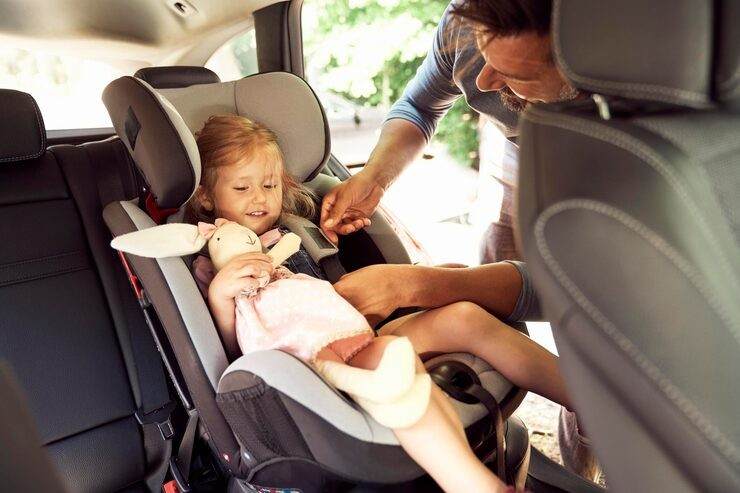
Even a suitable car seat may not provide its intended protection if it is installed incorrectly. Caregivers should read both the seat manufacturer’s instructions and the vehicle owner’s manual, then use an approved installation method.
The seat should be secured using the seat belt or lower anchors as permitted by the manuals. At the belt path, it should not move more than one inch side-to-side or front-to-back when checked according to NHTSA guidance. Harness straps should be snug and flat, and the seat should be positioned at the correct angle.
Bulky coats can interfere with harness fit. A safer approach is to buckle the child first and place a coat or blanket over the harness if additional warmth is needed.
Families can arrange assistance through a certified Child Passenger Safety Technician. The CDC explains that these technicians provide education and hands-on assistance with child restraint use. See the CDC prevention resource.
Check for recalls and expiration dates
Parents should periodically check the NHTSA recalls database and register their seats with the manufacturer. Recall information can identify safety problems requiring a repair, replacement, or other action.
Car seats also have manufacturer-specific useful-life limits. Parents should check the seat label and manual instead of assuming that all seats expire after the same number of years.
Secondhand seats require extra caution because their crash history, storage conditions, or recall status may be unknown. Before using one, verify its history, inspect its condition, check the expiration date, and make sure the necessary parts and instructions are available.
Should a car seat be replaced after a collision?
NHTSA recommends replacing a car seat after a moderate or severe crash. Replacement is not automatically necessary after every minor collision, but all of NHTSA’s criteria for a minor crash must be satisfied.
These criteria include whether the vehicle could be driven away, whether the door nearest the seat was damaged, whether anyone was injured, whether airbags deployed, and whether the seat has visible damage. The manufacturer may provide additional instructions.
Read NHTSA’s car seat guidance after a crash before deciding whether a seat can continue to be used.
Timeline: What to Do After a Child Passenger Crash
Because this article concerns general safety and legal principles rather than a specific lawsuit, there is no individual court timeline or active case status to report. The following chronology outlines practical steps after a collision.
- Immediately after the crash: Move to safety if possible, contact emergency services when needed, and obtain medical attention for anyone who may be injured.
- As soon as practical: Record the circumstances, gather available photographs and witness details, and obtain the police report or incident number.
- During the initial safety review: Identify the child restraint, review the manufacturer’s post-crash instructions, and determine whether the seat should be replaced.
- When product concerns arise: Check official recall information and preserve the seat and relevant documentation where appropriate.
- During the insurance investigation: Keep medical bills, treatment records, repair records, and communications organized.
- When legal responsibility is disputed: Consult a qualified attorney about negligence, possible product defects, evidence preservation, and the applicable filing deadline.
- Before any legal deadline expires: Determine whether a claim should be filed and which procedural requirements apply.
This chronology is general guidance, not a prediction that a lawsuit will be filed or succeed. Legal deadlines vary by state and claim type. Claims involving minors may have special rules, but families should not assume those rules automatically extend every deadline.
Expert Analysis: The Legal Challenges Behind Child Car Seat Claims
The legal issues arising from a child passenger injury can be more complicated than determining whether a driver followed a restraint law. A successful claim generally requires evidence supporting the relevant legal elements, and the rules differ depending on whether the claim concerns negligent driving, restraint use, or an alleged product defect.
Proving causation
Causation is often a central challenge. A plaintiff may need to show that a defendant’s conduct caused the injury or, in a product liability case, that a defect contributed to the harm. The exact legal standard varies by state and claim.
For example, proving that a harness was loose does not automatically establish that the loose harness caused a particular injury. Similarly, a seat that sustained damage during a serious collision is not necessarily defective. Investigators may need crash reconstruction, medical evidence, and technical analysis to determine what happened.
Anticipating defense arguments
A defendant or insurer may dispute fault, challenge the connection between the alleged conduct and the injury, or question the extent of the claimed losses. In a product case, a manufacturer may argue that the seat was used contrary to instructions or that the injury resulted from the collision rather than a defect.
These arguments must be evaluated against the evidence. Improper use may be relevant, but its legal effect depends on the governing law and whether the alleged error contributed to the injury.
Understanding filing deadlines
Personal injury and product liability claims are subject to statutes of limitations. These deadlines differ among states and may depend on the type of claim, the defendant, and the circumstances.
Claims involving children may be subject to special rules, but those rules are not uniform and may have exceptions. Claims against government entities, for example, can involve additional notice requirements.
Families should seek legal advice promptly rather than assume they can wait until a child reaches adulthood to pursue a claim.
Distinguishing a safety violation from civil liability
A violation of a child restraint statute may be relevant to a civil case, but it does not automatically establish liability. Courts may consider whether the violation is admissible, whether the statute applies to the circumstances, and whether the conduct caused the injury.
In my view, this is why legal analysis must remain evidence-based. Child car seat guidelines are essential for prevention, but a lawsuit requires more than showing that a safety rule was broken. The applicable law and the facts must support the particular claim.
Trusted Resources and Further Reading
The following official and research resources provide additional information about child passenger safety, state laws, recalls, and post-crash precautions.
- Centers for Disease Control and Prevention — Child Passenger Safety
National injury statistics and recommendations for protecting children in vehicles. - CDC — Preventing Child Passenger Injury
Evidence on car seat effectiveness, booster seats, and restraint safety. - National Highway Traffic Safety Administration — Car Seats and Booster Seats
Guidance on choosing, installing, and using appropriate child restraints. - Insurance Institute for Highway Safety — State Seat Belt and Child Seat Laws
State-by-state information about child restraint and seat belt requirements. - NHTSA — Vehicle and Child Seat Recalls
A searchable database for checking product recalls and safety notices. - NHTSA — Car Seat Use After a Crash
Official criteria for deciding whether a child restraint should be replaced following a collision. - American Academy of Pediatrics — Car Seats: Information for Families
Family-oriented guidance on selecting and using child restraints.
Key Takeaways
- Child passenger safety requires more than meeting a state’s minimum legal requirements.
- Properly used car seats and booster seats can substantially reduce the risk of injury.
- Parents should select restraints based on a child’s size, development, and the manufacturer’s limits.
- State requirements vary, so caregivers should check current laws before traveling.
- Improper restraint use may affect a personal injury claim, but it does not automatically determine who is legally responsible.
- A defective car seat may support a product liability claim if the evidence establishes the applicable legal requirements.
- Recall checks, correct installation, and manufacturer instructions are essential parts of prevention.
- After a crash, prioritize medical care, preserve relevant evidence, and check applicable legal deadlines.
- The best approach is to use the restraint that properly protects the child, not simply the one that satisfies the minimum legal rule.
Frequently Asked Questions
Are child car seat guidelines the same in every U.S. state?
No. States have different requirements for child restraint types, ages, heights, weights, and exceptions. Parents should check the current law in the state where they are driving and follow the seat manufacturer’s safety instructions.
Can improper car seat use affect a child’s injury lawsuit?
Yes, it may be relevant to causation or damages, depending on the evidence and state law. However, improper restraint use does not automatically eliminate a claim against a negligent driver or establish that a caregiver is legally responsible.
Can parents sue a car seat manufacturer if a child is injured?
Potentially, if evidence supports a legally recognized product defect or another valid claim. An injury alone does not prove that a seat was defective; the product’s condition, crash circumstances, warnings, and applicable state law must be evaluated.
Frequently Asked Questions
Are child car seat guidelines the same in every U.S. state?
No. States have different requirements for child restraint types, ages, heights, weights, and exceptions. Parents should check the current law in the state where they are driving and follow the seat manufacturer’s safety instructions.
Can improper car seat use affect a child’s injury lawsuit?
Yes, it may be relevant to causation or damages, depending on the evidence and state law. However, improper restraint use does not automatically eliminate a claim against a negligent driver or establish that a caregiver is legally responsible.
Can parents sue a car seat manufacturer if a child is injured?
Potentially, if evidence supports a legally recognized product defect or another valid claim. An injury alone does not prove that a seat was defective; the product’s condition, crash circumstances, warnings, and applicable state law must be evaluated.
Legal disclaimer: This article is for general informational and educational purposes only. It is not legal advice and does not create an attorney-client relationship. Laws, safety recommendations, and filing deadlines may change. Consult current official guidance and a qualified attorney for advice about a specific incident.
