

 By
Prorated rent allows tenants to pay for the portion of a rental period they are responsible for rather than automatically paying a full month’s rent. It commonly applies when someone moves into an apartment after the first day of the month or when a tenancy ends before the final day of a billing cycle. The amount is calculated by determining a daily rental rate and multiplying it by the number of days the tenant is responsible for the property.
For example, suppose an apartment costs $1,500 per month, and a tenant moves in on June 15. If the landlord uses the actual number of calendar days in June, the daily rent is approximately $50. The tenant occupies the property for 16 days, making the prorated rent $800.
Although the calculation appears straightforward, the rules surrounding partial-month payments can create disagreements between landlords and tenants. Different calculation methods can produce different amounts, and not every state requires landlords to prorate rent in every situation.
Understanding how prorated rent works is particularly important when negotiating a lease, planning a move, requesting a refund, or resolving a rental payment dispute. Tenants should also distinguish between moving out early under an existing lease and reaching the agreed-upon end of a tenancy. These situations can have very different financial and legal consequences.
This guide explains the calculation process, practical examples, landlord responsibilities, state-specific legal considerations, and ways to prevent disputes over partial-month rent.
What Is Prorated Rent?
Prorated rent is a partial rental payment calculated according to the number of days a tenant is entitled or obligated to occupy a rental property during a billing period.
Instead of charging the entire monthly rental amount, the landlord calculates a proportional amount for the applicable days.
For example, imagine a tenant signs a lease for an apartment with a monthly rent of $1,800. The lease begins on September 10, rather than September 1. If the parties agree to prorate the first month using September’s 30 calendar days, the tenant pays for 21 days instead of the entire month.
The calculation would be:
- Monthly rent: $1,800
- Days in September: 30
- Daily rent: $60
- Occupied days: 21
- Prorated rent: $1,260
This arrangement helps tenants avoid paying a full month’s rent for a partial rental period.
However, prorated rent is not automatically the same as a discount or refund. It is a method of calculating rent based on an agreed rental period and applicable legal requirements.
According to the Consumer Financial Protection Bureau (CFPB), approximately 35% of American households live in rental housing. With millions of households managing rental agreements, understanding payment calculations can help prevent unnecessary financial disagreements. Consumer Financial Protection Bureau
How Does Prorated Rent Work in the United States?
Prorated rent generally works by dividing the monthly rental amount into a daily rate and multiplying that rate by the number of billable days.
It commonly applies in three situations:
- Mid-month move-in: A tenant begins occupying a property after the first day of the month.
- Scheduled move-out: A lease ends before the last day of the month, and the tenant is responsible for only part of that final month.
- Agreed changes to occupancy: A landlord and tenant agree to adjust the rental period because of a change in possession or another arrangement.
For example, a tenant renting an apartment for $2,000 per month may receive the keys on October 20. Rather than paying the entire October rent, the landlord may charge for October 20 through October 31.
The landlord and tenant should establish which days count toward the payment. The date the tenant receives possession may matter more than the date they physically move their furniture into the apartment.
This distinction is important because a tenant may receive the keys several days before moving their belongings. If the rental agreement makes the property available from the earlier date, those days may still be included in the rent calculation.
The calculation method should also be clearly established. Some landlords divide monthly rent by the actual number of days in the month, while others use a standard 30-day month or an annual calculation.
The method used can change the final amount, even when the monthly rent and occupancy dates remain the same.
How to Calculate Prorated Rent: A Step-by-Step Guide
Calculating partial-month rent does not require complicated financial knowledge. Tenants and landlords generally need the monthly rental amount, the agreed calculation method, and the number of billable days.
The following steps explain how to calculate the amount accurately.
Step 1: Determine the Monthly Rent
Start by identifying the full monthly rental amount stated in the lease.
For example, assume the apartment costs $1,500 per month.
This amount serves as the basis for determining the daily rental rate.
Make sure you use the actual rent specified in the agreement rather than adding unrelated expenses such as utilities, parking fees, or optional services unless the agreement specifically includes them in the proration calculation.
Step 2: Identify the Number of Days in the Billing Period
The next step is determining the number of days used by the agreed calculation method.
If the landlord uses actual calendar days, the number changes depending on the month.
| Month | Number of days |
|---|---|
| January | 31 |
| February | 28 or 29 |
| March | 31 |
| April | 30 |
| May | 31 |
| June | 30 |
| July | 31 |
| August | 31 |
| September | 30 |
| October | 31 |
| November | 30 |
| December | 31 |
February has 29 days during a leap year and 28 days during other years.
This variation matters because dividing the same monthly rent by 28 days produces a higher daily rate than dividing it by 31 days.
If the lease specifies a standard 30-day calculation, use that method instead, subject to applicable law.
Step 3: Calculate the Daily Rental Rate
Use the following formula:
\[ \text{Daily Rent} = \frac{\text{Monthly Rent}}{\text{Days in Billing Period}} \]
For example, suppose the monthly rent is $1,500, and the landlord uses a 30-day calculation.
\[ \$1,500 \div 30 = \$50 \]
The daily rental rate is $50.
If the calculation uses the actual 31 days in January, the result changes:
\[ \$1,500 \div 31 = \$48.39 \]
The daily amount should generally be carried at full precision until the final calculation to avoid rounding errors.
Step 4: Count the Billable Occupancy Days
Next, identify the dates for which the tenant is responsible for rent.
For a mid-month move-in, count from the agreed possession or rental commencement date through the final day of the billing period.
For a scheduled lease expiration, count the days the tenant is entitled to occupy the property under the agreement and applicable law.
For example, if the tenant moves in on June 15 and the rental period ends on June 30, the billable period includes 16 days.
Always confirm whether the move-in or move-out date is included in the agreement’s calculation.
Step 5: Multiply the Daily Rate by the Billable Days
The final calculation is:
\[ \text{Prorated Rent} = \text{Daily Rent} \times \text{Billable Days} \]
Using the earlier example:
- Monthly rent: $1,500
- Daily rent: $50
- Billable days: 16
\[ \$50 \times 16 = \$800 \]
The tenant owes $800 for the partial month.
Step 6: Confirm and Document the Payment
Before making the payment, both parties should confirm the calculation.
A written breakdown should include:
- Full monthly rent.
- Calculation method.
- Daily rental rate.
- Move-in or move-out date.
- Number of billable days.
- Final prorated amount.
- Payment deadline.
Keeping these details in writing can help prevent disputes over the amount owed.
Different Methods Used to Calculate Prorated Rent
Not every landlord calculates partial-month rent in the same way. Three commonly used methods are the actual-calendar-day method, the 30-day method, and the 365-day annual method.
Understanding the differences is important because the same rental agreement can produce different partial-month amounts depending on the calculation method.
1. Actual Calendar-Day Method
Under this method, the monthly rent is divided by the actual number of days in the relevant month.
For example, if the rent is $1,800 and the tenant moves into an apartment on July 20, the calculation is:
- Monthly rent: $1,800
- Days in July: 31
- Daily rent: $58.06
- Occupancy period: 12 days
\[ \$1,800 \div 31 \times 12 = \$696.77 \]
The prorated rent is approximately $696.77.
This method accounts for differences between months and is relatively easy to verify using a calendar.
2. Standard 30-Day Method
Some landlords use a fixed 30-day month regardless of the actual calendar.
The formula is:
\[ \text{Daily Rent} = \frac{\text{Monthly Rent}}{30} \]
Suppose the monthly rent is $1,800.
\[ \$1,800 \div 30 = \$60 \]
If the tenant occupies the property for 12 days, the calculation becomes:
\[ \$60 \times 12 = \$720 \]
The prorated rent is $720.
The advantage is simplicity and consistency. However, it may produce a different amount from the actual-calendar-day method, particularly in February or 31-day months.
3. 365-Day Annual Method
The annual method calculates rent using the yearly rental amount rather than dividing each month’s rent separately.
The formula is:
\[ \text{Daily Rent} = \frac{\text{Monthly Rent} \times 12}{365} \]
For an apartment costing $1,800 per month:
\[ \$1,800 \times 12 = \$21,600 \]
\[ \$21,600 \div 365 = \$59.18 \]
If the tenant occupies the property for 12 days:
\[ \$59.18 \times 12 = \$710.14 \]
The result is approximately $710.14.
This method provides a relatively consistent daily rate throughout the year. However, landlords should clarify whether they use 365 or 366 days during a leap year and follow the lease and applicable legal requirements.
Comparison of the Three Calculation Methods
Consider a tenant paying $1,800 per month who occupies an apartment for 12 days.
| Calculation method | Daily rate | Rent for 12 days |
|---|---|---|
| Actual days in July (31) | $58.06 | $696.77 |
| Standard 30-day method | $60.00 | $720.00 |
| Annual 365-day method | $59.18 | $710.14 |
Prorated rent under three calculation methods
Example using $1,800 monthly rent and 12 billable days.
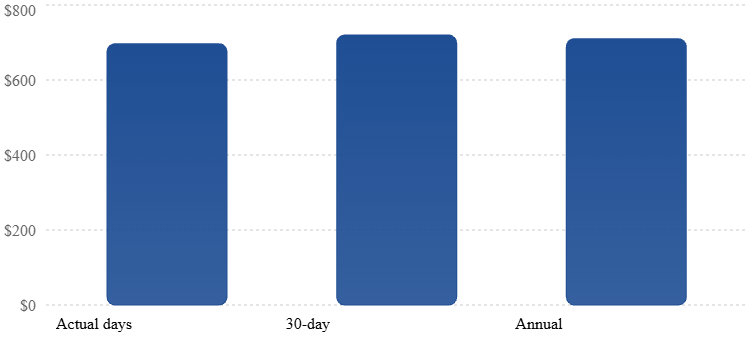
The difference between the highest and lowest amounts is $23.23.
Although this may appear insignificant, repeated calculation differences can create larger disagreements over a long rental period.
My recommendation: The actual-calendar-day method is a practical choice when the lease does not prescribe another method and local law permits it. It reflects the actual length of the billing month. However, the most important consideration is using a clearly disclosed, legally permissible method consistently rather than changing the calculation to benefit one party.
Practical Examples of Prorated Rent Calculations
Understanding the formula becomes easier when applied to everyday rental situations.
The following examples illustrate how partial-month rent works in different circumstances.
Example 1: Moving Into an Apartment Mid-Month
Suppose a tenant rents an apartment for $1,500 per month and receives possession on August 16.
August has 31 days.
| Particulars | Amount |
|---|---|
| Monthly rent | $1,500 |
| Days in August | 31 |
| Daily rent | $48.39 |
| Move-in date | August 16 |
| Billable days | 16 |
| Prorated rent | $774.19 |
Calculation:
\[ \$1,500 \div 31 \times 16 = \$774.19 \]
The tenant pays approximately $774.19 for the remaining 16 days of August.
Starting September 1, the regular monthly rent of $1,500 becomes due under the lease.
Example 2: Moving Out Before the End of the Month
Assume a tenant pays $2,100 per month and has a lease that ends on October 20.
If the tenant is entitled to occupy the apartment through October 20 and the parties use actual calendar days, the calculation is:
| Particulars | Amount |
|---|---|
| Monthly rent | $2,100 |
| Days in October | 31 |
| Daily rent | $67.74 |
| Final occupancy date | October 20 |
| Billable days | 20 |
| Prorated rent | $1,354.84 |
Calculation:
\[ \$2,100 \div 31 \times 20 = \$1,354.84 \]
If the tenant already paid the full October rent, the potential refund would be:
\[ \$2,100 – \$1,354.84 = \$745.16 \]
This assumes the lease and applicable law permit or require the rent adjustment and that no other lawful charges affect the amount.
Example 3: Moving Into an Apartment in February
Suppose the monthly rent is $1,400 and a tenant moves into the apartment on February 15 during a non-leap year.
February has 28 days.
The tenant is responsible for 14 days, from February 15 through February 28.
| Particulars | Amount |
|---|---|
| Monthly rent | $1,400 |
| Days in February | 28 |
| Daily rent | $50 |
| Billable days | 14 |
| Prorated rent | $700 |
Calculation:
\[ \$1,400 \div 28 \times 14 = \$700 \]
If the same arrangement occurred in a leap year, February would have 29 days, and the calculation would produce a slightly different amount.
These examples show why tenants should always verify the billing period and the method used before making a partial-month payment.
When Is Prorated Rent Usually Charged?
Prorated rent is most commonly associated with changes in the beginning or ending dates of a rental agreement.
However, other circumstances may also require a partial-month calculation.
| Situation | How prorated rent may apply |
|---|---|
| Mid-month move-in | Tenant pays for the agreed initial occupancy days |
| Lease ending mid-month | Final rent may be calculated for the remaining authorized occupancy period |
| New tenant takes possession | Rent is calculated according to the new tenancy’s start date |
| Change in rental commencement date | Parties may adjust the initial rental payment |
| Temporary occupancy agreement | Rent may be calculated according to the agreed short-term period |
| Landlord-approved early termination | Rent may be adjusted under the termination agreement |
An important distinction is that a tenant who simply leaves an apartment early does not automatically qualify for prorated rent.
For example, if someone signs a 12-month lease and moves out after eight months without a valid termination right or landlord agreement, they may remain responsible for rent under the lease. The landlord’s obligation to mitigate damages and applicable state law may also affect the amount recoverable.
Proration is therefore not a universal way to end a lease early without financial consequences.
Is a Landlord Legally Required to Prorate Rent?
There is no single nationwide rule requiring every private landlord in the United States to prorate rent whenever a tenant moves in or out during the month.
The legal requirement depends on state and local laws, the terms of the lease, and the circumstances surrounding the tenancy.
Some jurisdictions require prorated rent in specific situations, while others generally leave the issue to the rental agreement and negotiations between the parties.
For example, a landlord may agree to prorate the first month when a tenant moves in on the 15th. However, if the lease clearly establishes a different lawful payment arrangement, the tenant may not automatically have the right to demand a partial-month adjustment.
The following legal considerations are particularly important.
State-Specific Prorated Rent Laws
Minnesota
Minnesota provides a specific statutory protection for certain final-month rent calculations.
Under Minnesota Statutes § 504B.116, when a residential lease ends before the last day of the final month, the rent for that month must be prorated using the actual number of calendar days in that month.
The statute applies even when the lease requires the last month’s rent to be paid in advance. An agreement attempting to waive this protection is unenforceable.
Official reference: Minnesota Statutes § 504B.116. revisor.mn.gov+1
Washington
Washington does not impose a universal requirement to prorate every move-out payment simply because a tenant leaves during the middle of the month.
Tenant obligations can depend on the lease, notice requirements, and circumstances surrounding termination. Solid Ground, a Washington housing nonprofit, explains that tenants may need to negotiate a partial-month adjustment when moving out before the end of a rental period.
Official legal reference: Washington Revised Code § 59.18.200. Solid Ground
California
California rental payment obligations depend on the lease and applicable state and local laws. Tenants should not assume that moving into or out of a rental property mid-month automatically creates a statewide right to prorated rent.
The California Department of Real Estate provides general information about rental agreements and landlord-tenant responsibilities.
Reference: California Department of Real Estate.
These examples demonstrate why state-specific legal research is necessary. A rule applicable in Minnesota should not automatically be applied to a rental property in California or Washington.
What Does the Lease Say About Partial-Month Payments?
The lease is one of the first documents tenants should examine when a disagreement arises.
Look for provisions addressing:
- Rent commencement dates.
- Monthly payment deadlines.
- Partial-month rental calculations.
- Move-in and move-out dates.
- Early termination.
- Required written notice.
- Refunds and other final payments.
If the agreement specifies a particular proration method, both parties should understand how it works before signing.
For certain federally assisted housing arrangements, HUD lease requirements expressly address the initial or final partial month’s prorated rent. This is different from assuming that the same requirement applies to every private residential lease. hud.gov
What Are the Responsibilities of Landlords and Tenants?
Both landlords and tenants have responsibilities when handling partial-month rental payments. Clear communication and written agreements can prevent misunderstandings that might otherwise become landlord-tenant disputes.
Landlord Responsibilities
A landlord should:
- Explain the calculation method: Clearly communicate whether rent is calculated using actual calendar days, a 30-day month, or an annual method.
- Follow the rental agreement: Apply the agreed payment terms consistently, subject to applicable laws.
- Provide accurate payment details: Show the daily rate, billable days, and final amount.
- Avoid unauthorized charges: Do not add unexplained fees to a prorated payment.
- Provide payment records: Maintain receipts and documentation of rent received.
- Follow applicable refund requirements: Return any amount legally owed to the tenant within the required timeframe.
Tenant Responsibilities
Tenants should:
- Review the rental agreement before signing.
- Confirm the actual date when possession begins.
- Understand how partial-month payments are calculated.
- Pay the agreed amount by the specified deadline.
- Provide proper written notice before ending a tenancy.
- Keep payment receipts and communication records.
- Request written confirmation of any agreed rent adjustment.
In my opinion, the best way to prevent disputes is to discuss prorated rent before signing the lease rather than waiting until the first or final payment becomes due.
Can a Tenant Dispute an Incorrect Prorated Rent Calculation?
Yes. A tenant can question a prorated rent amount when they believe the landlord has applied the wrong calculation method, included incorrect occupancy dates, or charged an amount that conflicts with the lease or applicable law.
For example, imagine a landlord charges $900 for 15 days of occupancy when the agreed daily rate is $50. The correct calculation would be:
\[ \$50 \times 15 = \$750 \]
The tenant may dispute the additional $150 if it has no valid contractual or legal basis.
However, a disagreement over the calculation does not automatically mean that the landlord has violated the law.
Steps to Resolve a Prorated Rent Dispute
Step 1: Review the Lease Agreement
Check the payment terms, rental commencement date, calculation method, and any provisions concerning partial-month rent.
Step 2: Recalculate the Amount
Use the agreed formula to determine the correct payment. Check the number of days and whether the move-in or move-out date should be included.
Step 3: Request a Written Explanation
Ask the landlord or property manager to provide an itemized breakdown of the amount charged.
Step 4: Communicate the Disagreement
Explain the calculation error and provide the supporting figures. Keep the conversation professional and retain copies of all correspondence.
Step 5: Seek Housing or Legal Assistance
If the landlord refuses to correct an amount that appears inconsistent with the agreement or law, tenants can contact a local housing authority, tenant advocacy organization, or landlord-tenant attorney.
Step 6: Consider Legal Remedies
Depending on the jurisdiction and the circumstances, a tenant may have grounds to pursue a claim through small claims court or another appropriate legal process.
Tenants should avoid withholding the entire monthly rent simply because they disagree with a partial-month calculation. Rent withholding rules vary by state, and improper withholding can create additional legal problems.
Does Prorated Rent Affect the Security Deposit?
No. Prorated rent and security deposits are separate financial obligations, even though landlords may collect both around the time a tenant moves into a property.
Prorated rent covers the applicable portion of the rental period. A security deposit is generally held to cover qualifying obligations under the lease and applicable law, such as unpaid rent or damage beyond ordinary wear and tear.
For example, assume a tenant moves into an apartment on November 16.
| Payment | Amount |
|---|---|
| Monthly rent | $1,500 |
| Prorated November rent (15 days using a 30-day method) | $750 |
| Security deposit | $1,500 |
| Total initial payment | $2,250 |
The tenant pays $750 for the partial month and a separate $1,500 security deposit.
The security deposit should not automatically be treated as a payment toward prorated rent.
At the end of the tenancy, landlords must follow applicable state and local rules concerning security deposit deductions, itemized statements, and refund deadlines.
For additional information, consult the U.S. Department of Housing and Urban Development and your state’s tenant protection resources.
Common Mistakes to Avoid When Calculating Prorated Rent
Even a relatively simple calculation can cause disagreements when the parties misunderstand the rental period or use different formulas.
Here are common mistakes worth avoiding.
| Common mistake | Why it causes problems | How to avoid it |
|---|---|---|
| Using the wrong number of days | Produces an incorrect daily rate | Check the actual month and agreed method |
| Forgetting the move-in date | Undercharges or overcharges rent | Confirm whether the first day is included |
| Confusing physical move-in with possession | Creates disagreement over billable days | Use the agreed possession date |
| Rounding too early | Creates small calculation differences | Round the final amount to cents |
| Changing calculation methods | Creates inconsistent payments | Follow the lease and applicable law |
| Assuming early departure means reduced rent | May create unpaid rent obligations | Review termination rights and notice requirements |
| Mixing rent with the security deposit | Makes financial records unclear | Keep the two payments separate |
| Failing to document the agreement | Makes later disputes harder to resolve | Obtain written confirmation |
One particularly serious mistake is assuming that a tenant only owes rent for the days they physically sleep in the apartment.
Rental obligations are generally based on the lease and the tenant’s right to occupy the property, not simply the number of nights spent there.
For example, someone who travels for two weeks but continues to hold the lease and possession of an apartment generally remains responsible for the agreed rent.
Prorated Rent and the Financial Challenges of Renting in America
Partial-month rent calculations may seem like a minor administrative matter, but they can affect household budgeting, especially when tenants are already managing moving expenses, security deposits, utility connections, and other housing costs.
According to a January 2025 Consumer Financial Protection Bureau report, the share of renters incurring a late fee declined from 23% at the beginning of 2023 to 14% in November 2024.
The same report notes that approximately 35% of American households live in rental housing. Consumer Financial Protection Bureau
Rental payment context in the United States
35%
American households living in rental housing
14%
Renters incurring a late fee in November 2024
Source: CFPB, January 24, 2025. The late-fee figure is a rental payment indicator, not a measure of prorated rent disputes. Consumer Financial Protection Bureau
These figures highlight the importance of making rental payment terms understandable.
A tenant who does not understand the initial payment may struggle to budget for the first month. Similarly, an incorrect final-month calculation can create unnecessary financial pressure when someone is already paying for another home.
Landlords also benefit from transparent calculations because clear payment records can reduce billing disagreements and administrative work.
In my view, prorated rent should be treated as an important part of lease transparency rather than an informal arrangement discussed only when a tenant moves.
Frequently Asked Questions About Prorated Rent
1. How does prorated rent work in simple terms?
Prorated rent means paying only for the portion of a rental period covered by the tenant’s agreed occupancy or rental responsibility. The landlord calculates a daily rental rate and multiplies it by the number of billable days.
2. Is prorated rent calculated using 30 or 31 days?
It depends on the lease and applicable law. Some landlords divide monthly rent by 30, while others use the actual number of calendar days in the month. A third option is an annual calculation based on 365 days.
3. Do I have to pay a full month’s rent if I move in halfway through the month?
Not necessarily. If your landlord agrees to prorate the initial month, or applicable law requires it, you may only need to pay for the remaining rental days. Review your lease to confirm the payment arrangement.
4. Does prorated rent include the move-in date?
Generally, the move-in or possession date is included when the tenant’s rental responsibility begins on that date. However, the lease and applicable law determine the relevant dates and calculation.
5. Can landlords refuse to prorate rent?
In many private rental arrangements, landlords can refuse a requested adjustment if neither the lease nor applicable law requires proration. However, certain state laws require prorating in specific circumstances. Minnesota, for example, requires actual-calendar-day proration for qualifying final-month lease payments.
6. Do tenants receive prorated rent when moving out early?
Not automatically. Leaving before a lease expires does not necessarily end the tenant’s rent obligations. The result depends on the termination agreement, lease terms, notice requirements, and applicable state law.
7. Is prorated rent refundable?
It can be refundable when a tenant has paid more than the amount legally or contractually owed for the applicable rental period. The landlord’s refund obligations depend on the agreement and relevant laws.
8. Is the security deposit included in prorated rent?
No. A security deposit is separate from rent. It is generally collected to cover qualifying financial obligations under the lease and applicable law. The two amounts should be recorded separately.
9. What happens if a landlord calculates prorated rent incorrectly?
The tenant can request a written breakdown, review the lease, and explain the calculation error. If the issue remains unresolved, the tenant may seek help from a housing authority, tenant advocacy organization, or attorney.
10. Can landlords use an online prorated rent calculator?
Yes. Online calculators and spreadsheets can help landlords and tenants determine partial-month payments. However, the result is only reliable if the correct calculation method, dates, and billable days are entered.
11. Does prorated rent apply to commercial leases?
Yes, commercial landlords and tenants can agree to prorate rent for partial rental periods. However, commercial lease terms can differ significantly from residential agreements, so the parties should examine the contract carefully.
12. Can a landlord charge prorated rent and a full month’s rent in the same month?
Yes, when the payments cover different rental periods. For example, a tenant might pay prorated rent for the remaining days of August and then pay the regular September rent. The landlord should clearly explain the billing periods to avoid confusion.
13. Is prorated rent based on the days I actually live in the apartment?
Not necessarily. It is generally based on the days the tenant has the right or obligation to occupy the property under the rental agreement. Temporarily staying elsewhere does not normally eliminate rent obligations.
14. What if my apartment is not ready on the agreed move-in date?
If the landlord cannot provide possession as promised, the tenant may have contractual or statutory remedies. Depending on the circumstances, these may include delayed rent commencement, a rent adjustment, or other remedies under local law. Document the condition of the property and seek legal advice if the issue is not resolved.
15. When should prorated rent be paid?
The payment deadline should be established in the lease or written agreement. Many landlords collect initial prorated rent before handing over possession, while final-month rent is generally handled according to the lease’s regular payment schedule.
Additional Legal and Housing Resources
The following government publications and trusted organizations provide useful information about rental agreements, payment obligations, and landlord-tenant disputes in the United States.
| Resource | Information available |
|---|---|
| U.S. Department of Housing and Urban Development | Federal housing programs and tenant protections |
| Consumer Financial Protection Bureau | Consumer financial protection and rental payment research |
| USA.gov Housing Resources | Government housing assistance and rental information |
| Cornell Legal Information Institute | General landlord-tenant legal principles |
| Nolo Renters’ Rights | Practical information about tenant rights and responsibilities |
| Minnesota Statutes § 504B.116 | State law specifically addressing prorated final-month rent |
Further Reading and Research
For readers who want to understand rent calculations and housing payment practices in greater detail, the following publications are also useful:
- GISuser: Prorated Rent – A Simple Step-by-Step Guide — Explains the calculation process, different methods, and practical examples for landlords and tenants.
- Apartments.com: How to Prorate Rent — Provides examples of daily-rate and annual calculation methods.
- CFPB: Behind on Rent? Examining Rental Housing Delinquencies — Examines rental payment patterns and late-payment trends.
- HUD: Survey of State Laws Governing Fees Associated With Late Payment of Rent — Reviews state-level differences in rental payment regulations and late fees.
Key Takeaways
- Prorated rent is a partial rental payment based on the number of days a tenant is responsible for a property during a billing period.
- The basic formula is monthly rent divided by the agreed number of days, multiplied by the billable occupancy days.
- Three common calculation methods are actual calendar days, a standard 30-day month, and a 365-day annual calculation.
- The calculation method can significantly affect the final payment, so tenants should confirm it before signing a lease.
- Prorated rent commonly applies to mid-month move-ins and certain scheduled move-outs.
- Moving out early does not automatically eliminate the obligation to pay the remaining rent under a lease.
- There is no universal federal requirement that every private landlord prorate rent in every situation.
- State laws can provide specific protections. Minnesota, for example, requires actual-calendar-day proration for qualifying final-month rental payments.
- Security deposits and prorated rent are separate payments and should be documented independently.
- Written agreements, accurate calculations, and payment records can help prevent landlord-tenant disputes.
Final Thoughts
Understanding partial-month rental payments can make moving into or out of a rental property considerably easier. Although the calculation itself is relatively simple, differences in lease terms, billing methods, and state-specific regulations can affect how much a tenant owes or whether a refund is required.
The most practical approach is to confirm the rental commencement or termination date, identify the agreed calculation method, verify the number of billable days, and obtain a written breakdown of the payment.
Landlords should prioritize transparency, while tenants should review their agreements and question calculations that appear inconsistent with the lease or applicable law.
Ultimately, prorated rent is not simply about dividing monthly rent into smaller payments. It is about ensuring that rental charges reflect the correct contractual period and that both parties understand their financial responsibilities.
Disclaimer: This article is for informational and educational purposes only. It does not constitute legal advice or establish an attorney-client relationship. Landlord-tenant laws vary by state and locality. Consult a qualified housing attorney or local tenant assistance organization for advice about a specific rental dispute.
